
What Whitening Trays Do, and What They Cannot Do
Whitening trays are removable devices that hold a peroxide gel against your teeth for a set amount of time. The gel passes through enamel and breaks apart the pigment molecules trapped inside the tooth, so the tooth looks lighter. The tray itself does nothing except keep the gel where it belongs and off your gums.
That last point matters more than most people expect. A tray that fits badly leaks gel onto the gum line, which burns, and leaves gaps where the gel never reaches the tooth, which gives you a patchy shade.
Trays lighten natural tooth structure only. They do not change the color of crowns, veneers, bonding or fillings, so restorations on your front teeth can end up standing out against newly lighter neighbors. That is worth planning for before you start. For what does and does not work at home, see our overview of common whitening myths.
What This Guide Covers
How the gel works, the difference between custom and store-bought trays, how to wear them without hurting your gums, what they cost, and when to call a dentist. Our professional whitening page covers the supervised options.
Table of Contents
What Are Whitening Trays?
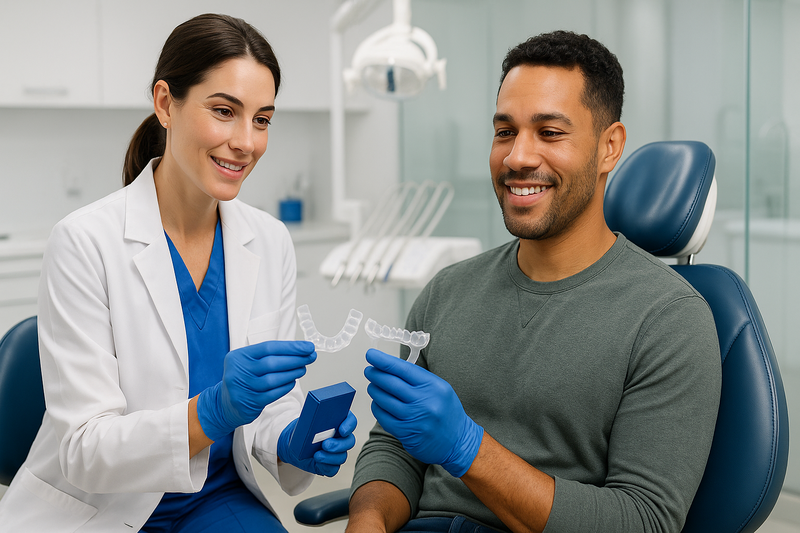
A tray is a thin, flexible shell that sits over one arch and carries a reservoir of bleaching gel. Take-home trays are worn in short sessions over a couple of weeks, a slower but gentler route than a single high-strength in-office appointment.
How the Gel Works
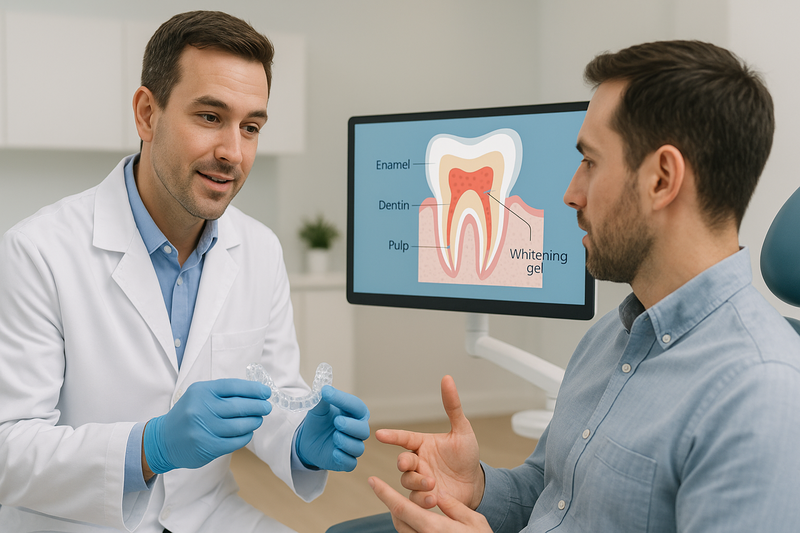
Two ingredients do nearly all the work: hydrogen peroxide and carbamide peroxide. Carbamide peroxide breaks down into hydrogen peroxide at roughly a third of its labeled strength, which is why take-home carbamide gels carry higher numbers than in-office gels of similar effect. Store kits sit at the low end of that range.
- Strength. Higher concentration works faster and irritates more. Lower concentration worn longer often reaches the same shade with less sensitivity.
- Fit. A tray trimmed to the gum line keeps gel on enamel. A bulky one-size shell pushes gel onto soft tissue, where peroxide causes a white, tender patch.
- Contact time. Peroxide keeps releasing for a limited window. Leaving trays in far longer than directed adds sensitivity, not shade.
Stains from coffee, tea, red wine and tobacco sit near the surface and respond well. Gray tetracycline discoloration, a tooth darkened after trauma, and age-related yellowing of dentin respond slowly or not at all.
Why Trays Are Worth Considering
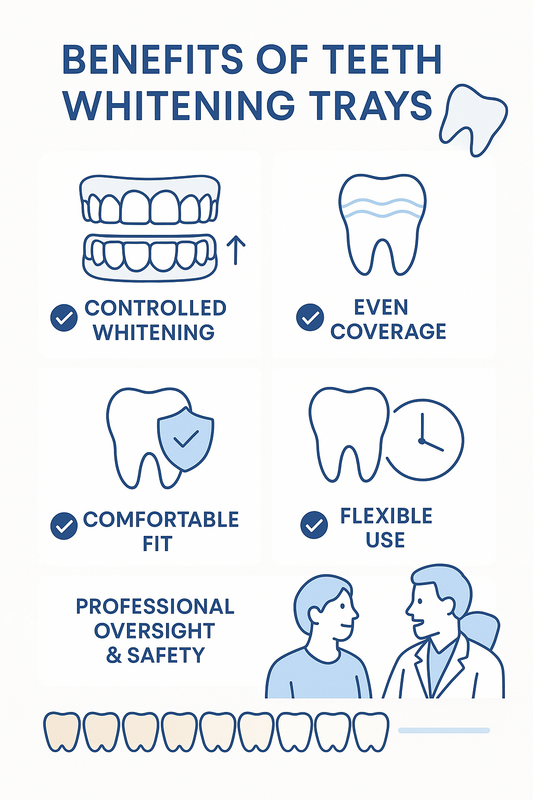
How trays deliver gel evenly and keep it off the gums.
- Gradual change. Shade shifts over days rather than in one sitting, so you can stop at the point you like instead of overshooting.
- Even coverage. A tray molded to your arch holds gel against the curved surfaces and between the front teeth, where strips tend to bridge over and leave darker edges.
- Gum protection. A tray scalloped at the gum margin keeps peroxide on enamel.
- Touch-ups. Once you own trays that fit, maintenance is a night or two of gel every few months rather than starting over.
What Dentist Supervision Adds
Beforehand we check for untreated decay, cracks, exposed roots and gum inflammation. Peroxide reaching a cavity or an exposed root is what turns mild sensitivity into real pain, and none of that is visible to you in the mirror. We also note where your crowns and fillings are, so you know which teeth will not change.
If sensitivity shows up mid-course, we can lower the concentration, shorten wear time, or add a fluoride or potassium nitrate gel rather than have you quit. See also our guide on keeping the result.
Custom Trays vs Store-Bought Trays
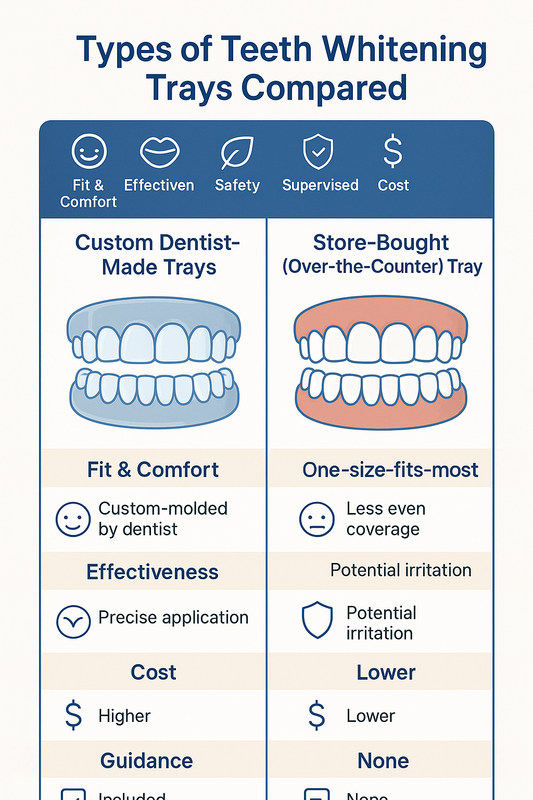
A side-by-side look at custom and store-bought trays.
There are three broad forms: custom trays made from a scan or impression, boil-and-bite trays you soften in hot water and press onto your arch, and rigid one-size shells sold with drugstore kits.
How They Compare
- Fit. Custom trays are made on a model of your arch and trimmed at the gum margin. Boil-and-bite versions usually cover some gum tissue. Rigid shells fit almost no one well.
- Evenness. The better the fit, the more uniform the shade. Rotated or crowded front teeth whiten unevenly in a generic tray.
- Sensitivity. Gel on the gums and gel pooling on an exposed root are the two main causes of discomfort, and both are fit problems.
- Cost. A drugstore kit is cheaper on day one. Custom trays cost more once, then you only buy refill gel.
- Oversight. Custom trays come with a supervised plan. Store-bought kits leave you to judge for yourself when something has gone wrong.
A store kit is a reasonable first try for mild surface staining on straight teeth with no restorations up front. Outside that, custom trays are usually cheaper once you count the kits that did not work.
How to Use Whitening Trays Safely
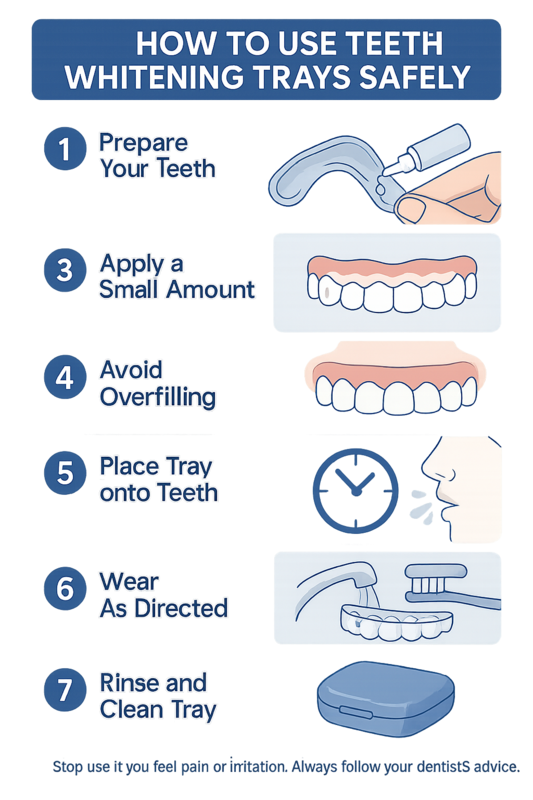
The sequence, from preparing your teeth to storing the trays.
Step by Step
- Clean and dry. Brush and floss, then rinse. Gel works better on a clean surface, and a dry tray holds it in place.
- Use less gel than you think. A drop the size of a grain of rice per tooth compartment is enough. Overfilling is the most common mistake and pushes gel onto the gums.
- Seat it gently. Press evenly with your fingers, do not bite it into place, and wipe any gel that squeezes onto the gum line with a cotton swab.
- Wear it for the time you were given. Typically 30 minutes to a few hours. Do not sleep in them unless your dentist said to with that specific gel.
- Rinse afterward. Rinse your mouth with water and spit. Do not swallow leftover gel.
- Clean the trays. Cool water and a soft brush. Hot water warps them. Air-dry before storing in the case.
- Protect the first few hours. Enamel is briefly more absorbent after a session, so hold off on coffee, tea, red wine, berries and tomato sauce.
Brief zingers during a course are common and settle within a day or two of finishing. Some people should be seen before starting at home: anyone with untreated decay or active gum disease, anyone with enamel erosion or exposed roots, children and teenagers, and people who are pregnant or nursing, who should wait.
Stop and call us if the sensitivity is sharp rather than dull, lingers between sessions, if your gums turn white or stay sore, or if one tooth starts to ache. A single aching tooth often means something was already going on inside it.
Cost and Long-Term Value
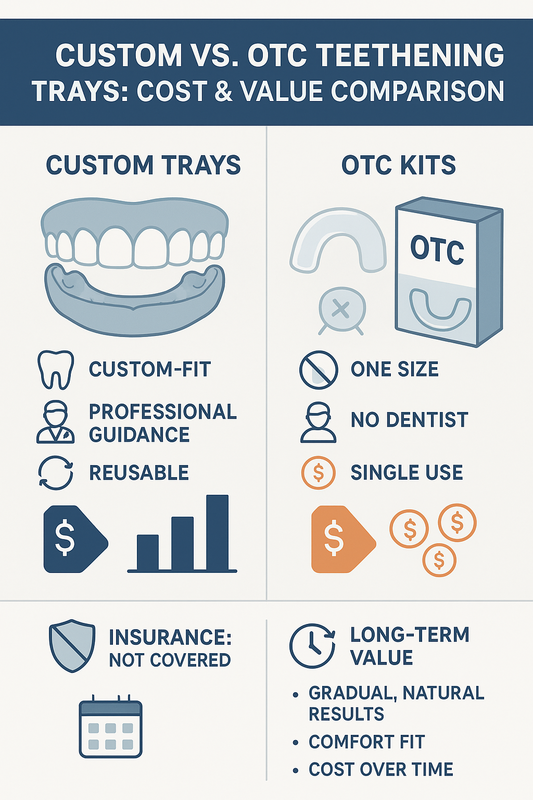
What drives the price difference between custom and store-bought trays.
Three things drive the price: whether the trays are custom made, the strength and quality of the gel, and how much chairside time and follow-up is included. Custom take-home trays sit between a drugstore kit and a full in-office appointment. We quote the figure at your consultation, since it depends on which arches you treat and which gel suits your sensitivity.
Insurance and What You Get Over Time
Dental insurance does not cover whitening. It is classified as cosmetic, so plan on paying out of pocket wherever you have it done.
The value argument for custom trays is the trays themselves. Kept clean and dry they last for years, and holding your shade afterward means a syringe of refill gel now and then.
When to Involve a Dentist
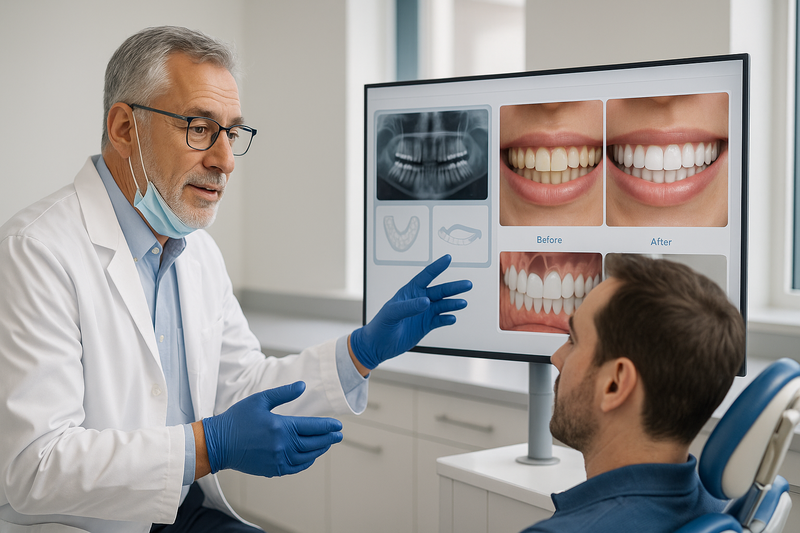
You do not need a dentist to buy gel. You do need one in these situations.
- You have crowns, veneers or bonding on your front teeth. They will not lighten, and the plan has to account for that.
- Your teeth already feel sensitive. That usually points to exposed root or worn enamel, both of which need a lower strength gel and a trimmed tray.
- One tooth is darker than the rest. A single dark tooth is often a nerve problem, not a stain, and external whitening will not fix it.
- A kit got you nowhere, or hurt. Either the staining is not the type that bleaches, or the fit was the problem.
Care at Our Marina del Rey Office
At Elegant Dentistry in Marina del Rey we start with an exam and a shade record, so there is a real baseline to compare against rather than a memory. Consultations and second opinions are free, and we will say plainly if we think this will not get you what you are after.
Frequently Asked Questions
Are whitening trays safe?
Peroxide whitening has a long clinical track record and is safe for healthy teeth and gums when used as directed. The risks come from untreated decay, gum disease, exposed roots and poorly fitting trays, not from the ingredient itself.
How long before I see a difference?
Most people notice a change within a few days and reach the result they keep after one to two weeks of daily sessions. Surface stains from coffee and tea move fastest. Age-related yellowing and gray tetracycline staining move slowly, and some of it does not move at all.
Can whitening damage my enamel?
Used at normal strengths and wear times, peroxide gels do not measurably weaken enamel. Overuse causes sensitivity and irritated gums instead. Running back-to-back courses because the shade is not moving is a sign to stop and find out why.
How often can I use my trays?
Daily during the initial course, then only for touch-ups. For most patients that means a night or two every few months, depending on how much coffee, tea and red wine are in the picture.
Are dentist-provided trays ADA approved?
The ADA does not approve procedures. It awards a Seal of Acceptance to individual products that meet its safety and effectiveness criteria, and many professional systems use materials that qualify. Ask which gel is being used and why it was chosen for you.
Schedule a Whitening Consultation
The visit is short. We check for decay, cracks and gum inflammation, note where your restorations are, record your starting shade, and tell you what a realistic result looks like. If trays are the right tool, we take the scan at that visit.
Consultations and second opinions are free, so deciding between a store kit, take-home trays and in-office treatment costs you nothing. Our whitening services page explains how the two professional options are often combined.
How We Approach It
We would rather get you a shade you keep comfortably than the lightest one you cannot tolerate. That means starting at the gel strength your teeth can handle, adjusting if sensitivity shows up, and saying so when bleaching is not the right answer.
Final Thoughts
Trays work, within limits. Fit determines how even the result is and how much your gums complain. Gel strength and wear time determine how fast you get there and how sensitive you feel along the way. Neither lightens a crown, a filling or a tooth that darkened from the inside.
If your teeth are healthy, your front teeth have no restorations, and the staining comes from what you drink, a tray course is worth trying. If any of that is not true, an exam first will save you time and money.